Constraint-driven investigations in language, image, and sound.
These are not portfolio pieces. Each study here is a sustained investigation with a question
at its center — what computation can know about its own
decay,
what makes a generated field feel
alive,
what dissolution sounds like taken seriously as compositional material,
what a story can know about a domain it borrows.
The practice is the method: artifacts public, sources in their repositories, lab journals
kept along the way.
Research program
Senescent Computation
Programs that age — seven esoteric languages ordered by their deepening relationship with decay.
From programs that undergo degradation invisibly, to programs that observe it, to
languages where commitment and verification are primitives. The axis runs from
Malbolge to verify — and it keeps going.
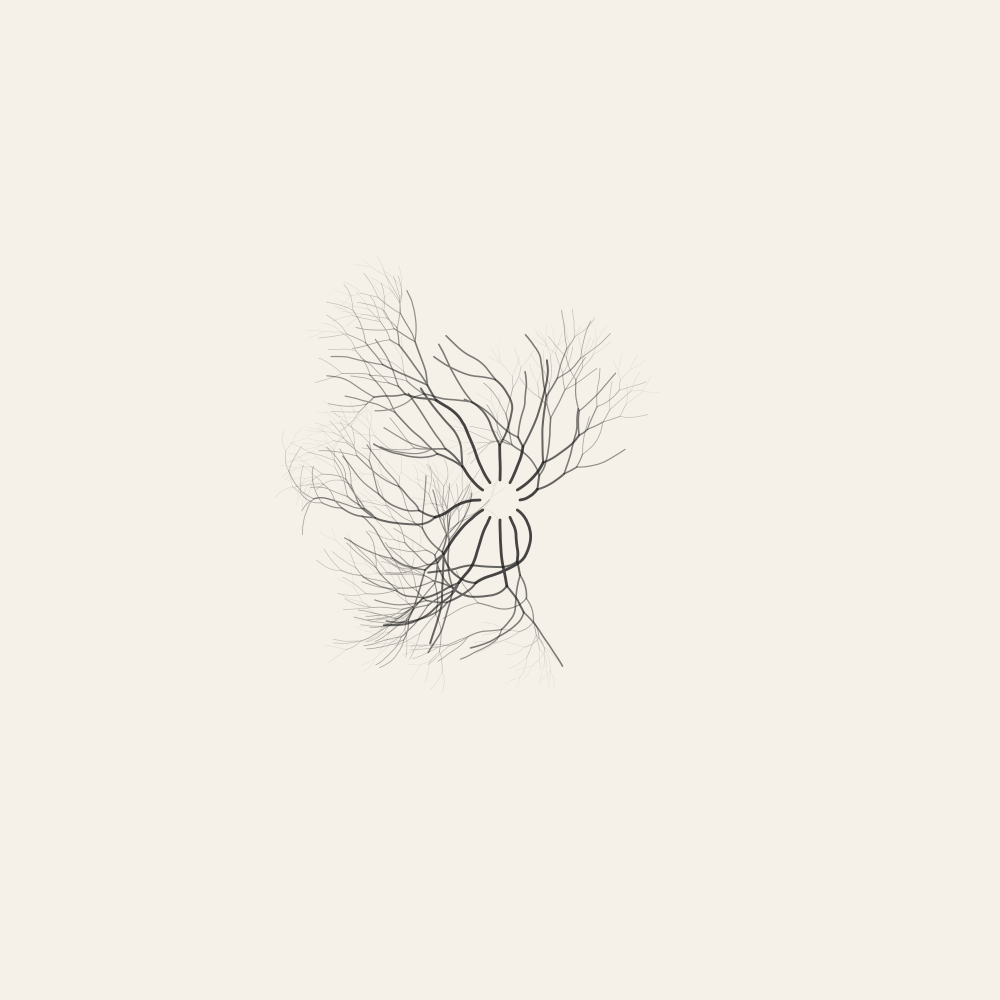
Generative fields, attractors, dendrites — what focal structure does to how a composition feels.
Fifteen curated pieces in five series — particle tracing, dendritic growth, coupled
systems — every one reproducible from its seed. No post-processing; the system's
rules do all the drawing.
Parametric dissolution — Sonic Pi studies on structure losing itself, honestly.
Twenty-nine studies, roughly four hours, in five sections — erosion, wraith,
register, idiom, basin. Rendered through a headless Sonic Pi pipeline; fourteen
studies published as lossless audio.
A cross-model study of aesthetic judgment on generated structure.
What makes a generated field feel alive rather than merely correct? Eight LLMs from
seven labs unanimously agree: convergence topology, not complexity, drives aesthetic
quality. Seven figures, four testable hypotheses, a complete explanatory chain from
structure to experience.
Stories tested as instruments of knowing — each built on a spine of verified sources.
Eighteen pieces in the custody series, fourteen domains: conservation
genetics, waterlogged wood, textile conservation, literary translation,
forensic handwriting — and, most recently, the root-key ceremonies. Every
factual claim checked before the draft, audited after. The series keeps
finding the same shape: each domain is custody of something that changes
while you hold it — and authenticity is variance with a body in it.
A forger can copy the mean, never the trajectory.
2026 · prose · 18 pieces · the shelf ships with the paper — one exception, timed to its subject
Research holds sustained investigations — the
Gallery
holds single artifacts, and the
Lab
holds live demos. Sources, lab journals, and render pipelines live in each study's
GitHub repository.